
 Bonnie Coffa Bonnie Coffa
FDA's Focus on Review Efficiency, Scientific Evidence, Product Modifications, and Market Authorization
The first day of the 2026 FDLI Tobacco and Nicotine Products Regulation and Policy Conference provided valuable insight into the evolving regulatory landscape for tobacco and nicotine products. Discussions involving leadership and scientific reviewers from FDA's Center for Tobacco Products (CTP), along with industry representatives, highlighted both progress and persistent challenges in the premarket review process.
Four themes emerged:
- Review capacity
- Streamlined regulatory pathways
- Scientific evidence expectations
- Product lifecycle management
PMTA Review Capacity Remains a Significant Challenge
CTP reported substantial progress in reducing its premarket tobacco product application (PMTA) backlog, with pending applications reportedly decreasing approximately 70% since the beginning of 2025 and applications awaiting acceptance review decreasing by more than 99%.
However, the underlying capacity challenge remains. CTP currently operates nine PMTA scientific review teams, and substantive review of new applications depends on reviewer availability.
CTP leadership expressed interest in more than doubling scientific review capacity, although additional hiring flexibility may require legislative changes.
Industry implication: Reduced application backlogs do not necessarily translate into predictable authorization timelines. Submission quality and efficient scientific review remain critical.
The Supplemental PMTA Pilot Could Improve Product Modification Pathways
The supplemental PMTA (sPMTA) pilot represents a potentially important development for manufacturers seeking to modify authorized products.
The conference discussions described targeted review periods of approximately:
- 90 days: Minor modifications
- 135 days: Moderate modifications
- 180 days: Complex modifications
These periods were described as running from substantive review initiation rather than initial submission, with no deficiency-letter cycle currently included in the pilot.
Importantly, FDA emphasized that the statutory Appropriate for the Protection of the Public Health (APPH) standard remains unchanged for supplemental applications.
Certain device modifications, ingredient substitutions, and flavor changes may be eligible, depending on the product and proposed change. Modifications to nicotine concentration, salt form, or source were described as outside the pilot's current scope.
Industry implication: A streamlined review pathway does not eliminate the need for adequate product characterization, harmful and potentially harmful constituent (HPHC) data, exposure assessment, and supporting toxicological evidence.

Scientific Bridging Must Be Supported by a Clear Rationale
One of the most relevant discussions for regulatory toxicologists concerned the use of scientific bridging between products.
CTP indicated that bridging is evaluated across scientific disciplines and must be supported by a clear, scientifically defensible rationale.
For oral nicotine pouches, product characteristics such as pH and free nicotine were specifically highlighted as important determinants of nicotine pharmacokinetics.
This reinforces the need to demonstrate that analytical, formulation, and exposure differences do not undermine the relevance of existing data.
Industry implication: Bridging should be treated as a structured scientific justification rather than simply an assertion of product similarity. The rationale should identify relevant differences, their potential toxicological or exposure implications, and the evidence supporting comparability.
Category-Based Review Frameworks Could Reduce Redundant Testing
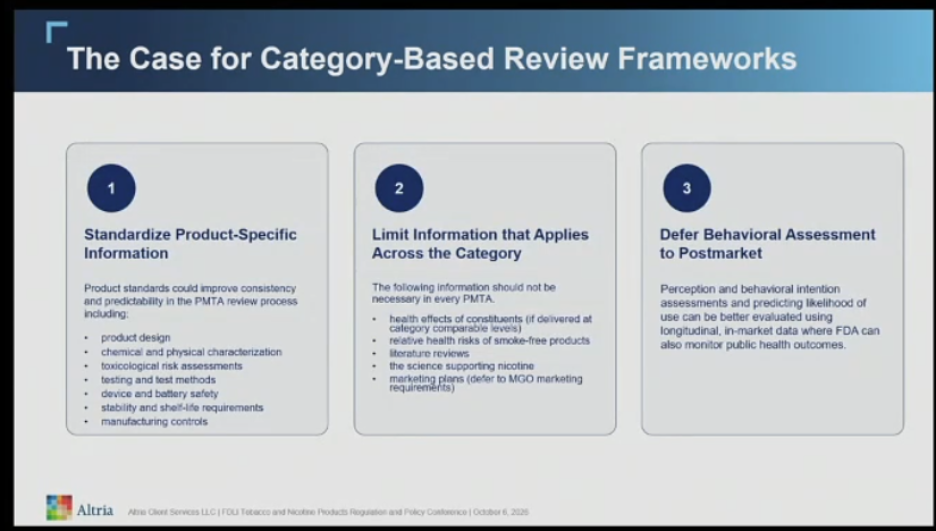
Industry representatives advocated for more standardized, category-specific review approaches that could reduce repetitive data requirements.
Proposals included greater reliance on chemical characterization, ingredient toxicology, short-term behavioral studies, and validated models for predicting nicotine pharmacokinetics.
FDA representatives expressed openness to modeling approaches while emphasizing the need for validated methods and confidence in the predictive value of proposed endpoints.
Voluntary consensus standards, including those developed through CORESTA, were identified as a potentially practical route toward greater review consistency.
Industry implication: Standardized analytical methods, validated in vitro models, and scientifically supported exposure predictions could become increasingly valuable components of regulatory submissions. However, proposed efficiencies should not be interpreted as established reductions in current PMTA requirements.
Product Modifications Require Early Regulatory Planning
The modifications and market survival panel highlighted the regulatory implications of changes that manufacturers may otherwise consider routine.
Potentially consequential changes include:
- Ingredient specifications and target concentrations
- HPHC profiles without demonstrated analytical equivalence
- Container-closure systems and product sizes
- Certain suppliers and product design parameters
CTP encouraged manufacturers to consider foreseeable variations when preparing initial applications and to engage FDA project managers early when modifications become necessary.
Industry implication: Product lifecycle management should begin during initial product development. Incorporating justified formulation ranges, supplier alternatives, and design specifications may reduce the need for future submissions, where supported by the applicable authorization pathway.
Market Authorization, Enforcement, and Youth Protection Remain Interconnected
CTP also emphasized the continued challenge posed by unauthorized e-cigarette products and the importance of addressing youth appeal.
Conference discussions highlighted age-restriction technologies as a potentially meaningful factor in evaluating certain flavored ENDS products.
FDA leadership also emphasized that manufacturers are responsible not only for the characteristics of their products but also for how those products are promoted.
Industry implication: Regulatory strategies must consider product design, consumer behavior, youth access prevention, and marketing practices alongside chemical and toxicological safety.
Age-Gated Flavored ENDS: A Potential Regulatory Evolution
A Day 2 panel, Flavored, Age-Gated, Authorized: Youth Protection Meets Harm Reduction?, explored the implications of FDA's authorization of GLAS flavored ENDS products incorporating device access restriction (DAR) technology.
The technology described during the session combines government-issued identification, biometric verification, periodic identity reauthentication, and proximity-based device controls intended to prevent unauthorized use.
Although panelists reported 100% effectiveness in the testing conducted, FDA's Office of Science Director, Dr. Matthew Farrelly, emphasized that the available testing involved a limited sample and that real-world effectiveness remains to be established.
Importantly, FDA indicated that when device access restrictions can be demonstrated to effectively prevent youth access, the evidence of adult switching benefits may be evaluated similarly to that supporting tobacco-flavored ENDS.
Regulatory implication: Effective age-gating technology may reduce the youth-risk component of the APPH assessment, potentially changing the behavioral evidence needed to support certain flavored ENDS applications. However, authorization remains dependent on the totality of product-specific evidence.
Behavioral Evidence Remains Critical to Demonstrating Public Health Benefit
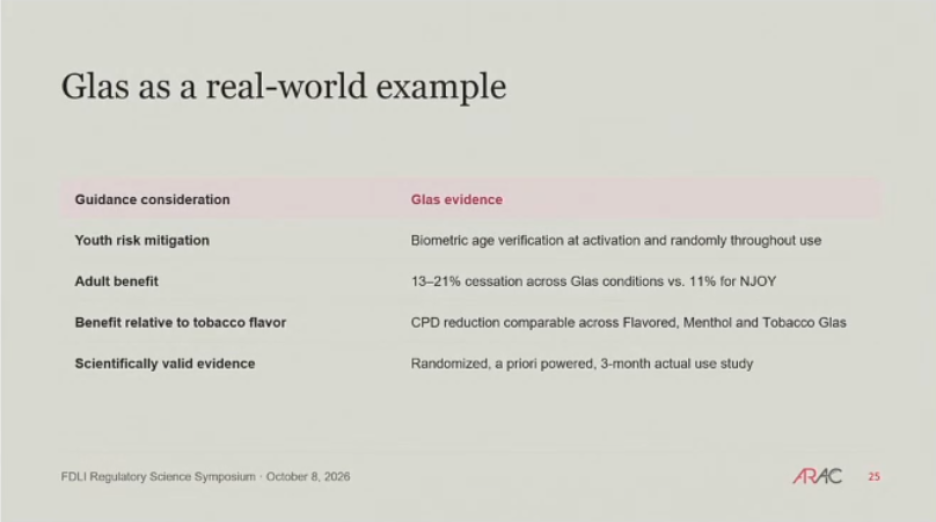
The GLAS switching study, presented by Jessica Zdinak of ARAC, provided an example of behavioral evidence supporting an authorization decision.
Reported findings included:
- 13–21% smoking cessation after three months across three GLAS conditions, compared with 11% for an authorized comparator product.
- Approximately 45% of participants reduced cigarette consumption by at least 50% after three months.
- Significant reductions in exhaled carbon monoxide from baseline across the GLAS conditions.
- No statistically significant differences in attrition between older and younger participants, with dropout reportedly unrelated to the age-verification technology.
These results were presented as evidence of potential adult smoking reduction and switching benefits, rather than proof that particular flavors independently improve cessation.
Panelists also emphasized that behavioral study designs should reflect the overall risk profile of the product, including chemical characterization, toxicant exposure, product usability, and youth access restrictions.
Regulatory implication: Strong youth access controls do not eliminate the need for behavioral evidence. Rather, they may influence how much evidence is necessary to demonstrate a favorable population-level risk-benefit balance.
Flavor Preferences, Youth Protection, and the Broader Marketplace
The panel highlighted continuing uncertainty regarding the contribution of specific ENDS flavors to smoking cessation.
Cristine Delnevo of Rutgers University described strong evidence that flavors increase youth appeal and contribute to experimentation and initiation, while evidence that particular flavors independently improve adult smoking cessation remains inconsistent.
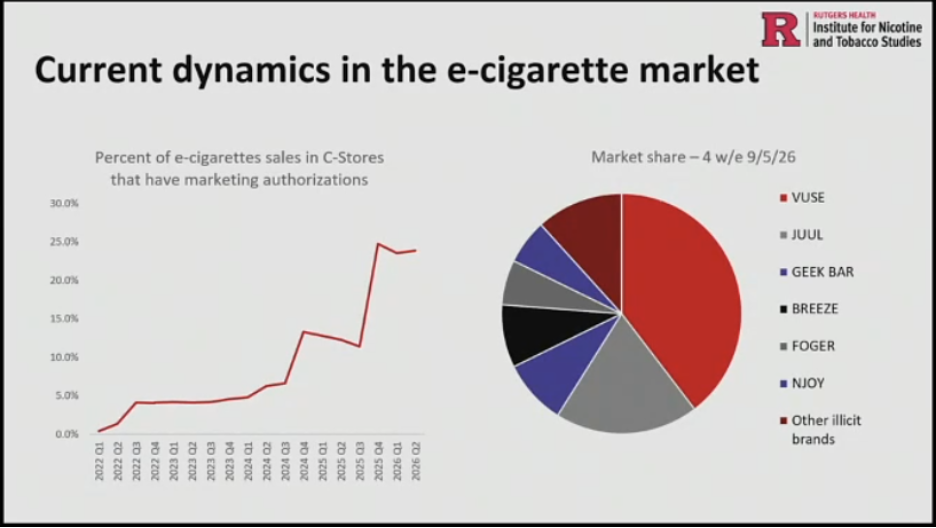
Panelists also discussed the continued availability of unauthorized flavored disposable ENDS products and the limitations this creates for assessing the population-level impact of authorized, age-gated products.
Beyond device-based restrictions, electronic identification scanning at retail locations was presented as another potential strategy for reducing underage access.
Regulatory implication: Future evaluations of flavored nicotine products may benefit from a broader approach that integrates device access controls, retail age verification, actual-use behavioral evidence, and real-world surveillance.
FDLI 2026 Tobacco and Nicotine Products Regulation and Policy Conference Conclusions
Across both days, FDLI 2026 discussions highlighted an evolving approach to tobacco and nicotine product regulation.
The major themes were consistent: improve review efficiency, strengthen the scientific basis for regulatory decisions, support well-justified product modifications, and evaluate emerging technologies that may reduce youth access while preserving opportunities for adult smokers to transition away from combustible cigarettes.
For regulatory scientists and manufacturers, the central priority remains developing comprehensive, scientifically defensible evidence packages that integrate product chemistry, toxicology, exposure, behavioral outcomes, and youth protection.
The emerging opportunity is not simply faster authorization, but more efficient, evidence-based evaluation of products and technologies capable of demonstrating meaningful public health benefits.
Looking Ahead
The discussions at FDLI 2026 suggest that FDA is exploring ways to improve regulatory efficiency without fundamentally changing the scientific and public health standards governing tobacco product authorization.
For manufacturers and regulatory scientists, several priorities are clear:
- Develop scientifically robust, well-characterized submissions.
- Support bridging approaches with transparent analytical and toxicological justifications.
- Anticipate product modifications during initial regulatory planning.
- Monitor developments in supplemental PMTA pathways and voluntary consensus standards.
- Integrate youth access prevention and responsible marketing into product lifecycle strategies.
The central takeaway: Regulatory efficiency and scientific rigor are not competing objectives. Well-designed studies, defensible exposure assessments, validated methods, and clear scientific rationales can support both effective regulatory review and responsible product innovation.
Contact Labstat to talk about how we can help with your PMTA submission.