Reviewed By Alexandra Kommatas-Stanisz, Microbiology & Cannabis Lab Manager, Labstat International
Nicotine pouch sales continue to grow, reshaping the industry through their reduced-harm potential. But the necessary microbiological testing for pathogen detection still relies on traditional culture-based approaches that can require multiple media, incubation periods, and confirmation steps. Plus, the turnaround time is about four days, and businesses always want defensible data as quickly as possible.
Recently, Labstat International’s microbiology team was presented with an opportunity to help move the science forward.
When Medicinal Genomics approached Alexandra Kommatas-Stanisz, Labstat Microbiology & Cannabis Lab Manager, about evaluating its PathoSEEK® qPCR Detection Assays with MaGiC™ Lysis, Kommatas-Stanisz proposed applying it to nicotine pouches. She worked with Meghana Urdhwareshe, Labstat Micro Lab Tech, and the Medicinal Genomics team to answer a practical question:
Could a rapid qPCR-based method reliably detect specified microorganisms in real nicotine pouch matrices while performing comparably to USP compendial methods?
To find out, the study evaluated 240 test portions across 20 pouch flavors and four microorganisms.
“The broader significance is demonstrating that a rapid microbiological method can perform well in the actual product matrix.”
— Alexandra Kommatas-Stanisz, Labstat
Putting a Rapid Method to a Real-World Test
The study evaluated Medicinal Genomics’ PathoSEEK® multiplex qPCR assays with MaGiC Lysis for:
- Staphylococcus aureus
- Pseudomonas aeruginosa
- Salmonella spp.
- Escherichia coli spp.
Twenty nicotine pouch flavors were tested. One-gram portions were inoculated at the following levels:
- 1–2 CFU, near the limit of detection
- ~50 CFU
- ~100 CFU
Samples were then analyzed in parallel using PathoSEEK and the applicable USP compendial method.
DNA extraction and qPCR setup were automated using a Bio Molecular Systems Myra liquid handler.
“The study was designed to evaluate the method under realistic testing conditions rather than simply demonstrating performance in an ideal matrix,” said Heather Ebling, Director of Applications and Support, Medicinal Genomics.
The Challenge Was the Matrix, Not Just the Organisms
One of the biggest challenges the team faced was the natural antimicrobial effects that nicotine, pouch constituents, and flavorings can have. Labstat has seen particularly strong effects in some menthol and mint products, raising a concern:
Would the matrix suppress organisms present near the detection limit?
Dilution or neutralizers can sometimes address antimicrobial matrices, but they were not needed here. The team successfully recovered organisms from the study pouches using the PathoSEEK workflow—a result Urdhwareshe called a “pleasant surprise.”
Creating the ~1–2 CFU spikes presented another challenge. Small errors could determine whether any organism was present to recover. Kommatas-Stanisz and Urdhwareshe calculated organism-specific spikes from reference pellets while maintaining the sample dilution factor.
The team also staggered work by organism to minimize cross-contamination, coordinating three spike levels while maintaining consistent incubation timing.
Medicinal Genomics trained Labstat on MaGiC Lysis and the Myra liquid handler. Automation reduced plate-preparation work, but the approximately month-long project still required microbiological judgment to design accurate spikes, control contamination risk, and interpret performance.
What the Results Showed
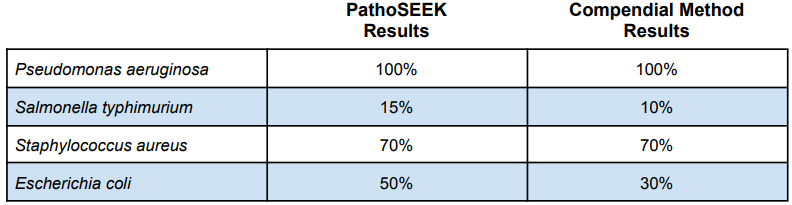
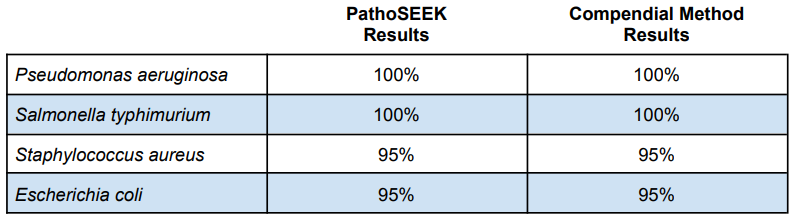
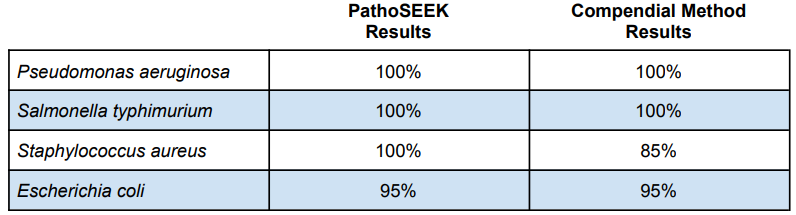
Across all samples, the qPCR and USP methods were concordant 96% of the time, as the following tables show. See the Medicinal Genomics Application Note for complete results.
Percent Detection: Low-Level Spike (1–2 CFU)
Percent Detection: Mid-Level Spike (~50 CFU)
Percent Detection: High-Level Spike (~100 CFU)
What This Could Mean for Nicotine-Product QC Laboratories
For Kommatas-Stanisz, a key customer benefit is turnaround time. The traditional compendial workflow takes about four days, while the PCR approach can provide results in approximately 48 hours.
Urdhwareshe also noted that a shorter, automated workflow reduces analyst effort and manual variables. The Myra liquid handler automated DNA extraction and PCR setup, reducing hands-on preparation while analysts remained responsible for controls, troubleshooting, and interpretation.
“For us, the biggest takeaway is being able to play a role in advancing the science of the nicotine industry.”
— Meghana Urdhwareshe and Alexandra Kommatas-Stanisz, Labstat
Advancing Molecular Microbiology in Nicotine Testing
For Labstat, the project went beyond evaluating one assay. It demonstrated how a nicotine-focused laboratory can help technology developers test new microbiological approaches against real product complexities.
The team’s main takeaways:
- Antimicrobial ingredients can complicate microbial recovery in real matrices.
- Low-level challenges demand careful spike calculations, timing, and controls.
- Automation complements scientific expertise rather than replaces it.
- Rapid methods can offer practical QC benefits when performance is demonstrated for the intended matrix.
Medicinal Genomics also credited Labstat’s experience with helping make the study relevant to routine testing. Eaton said Labstat’s familiarity with both nicotine products and microbiology helped shape the study design and interpretation of the results.
“Labstat’s technical expertise, attention to detail, and willingness to work collaboratively made them an ideal partner for evaluating PathoSEEK in this emerging application.”
— Heather Ebling, Medicinal Genomics
The study adds evidence supporting rapid molecular microbiology in nicotine-product testing while illustrating the role laboratories can play in advancing testing science: selecting relevant matrices, designing meaningful challenges, executing comparative studies, and generating defensible data the industry can evaluate.
Contact our team to discuss micro testing for your nicotine pouch samples.